Data Beyond
Limits
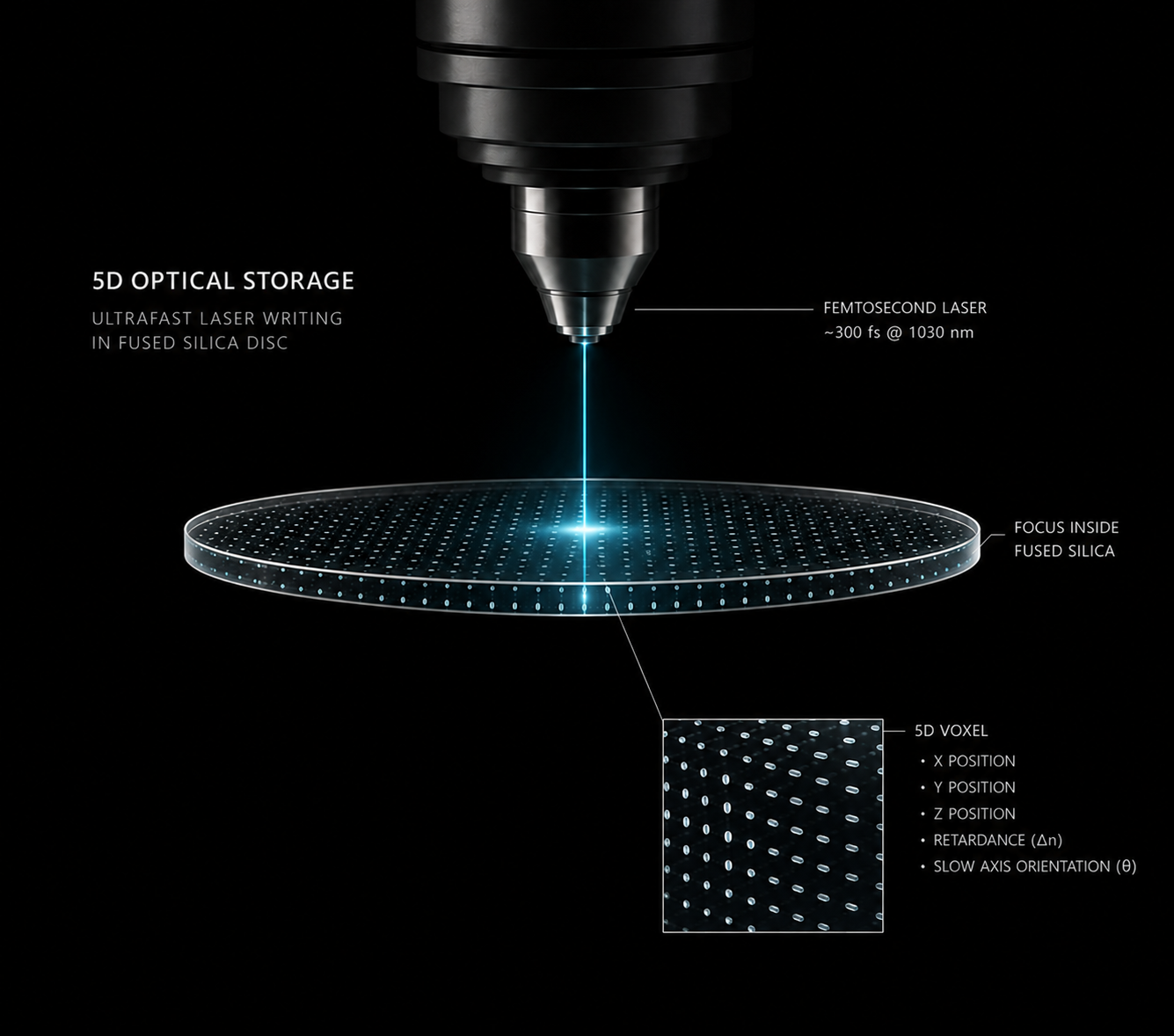
Ultrafast femtosecond lasers encode information within fused silica using volumetric nanoscale structures across five physical dimensions, creating passive optical storage engineered for long-term archival applications.
Built For Performance.
Not Built For Centuries.
Modern storage infrastructure was designed for speed, accessibility, and scale, not indefinite preservation. As storage systems age, organizations face recurring migration cycles, increasing operational costs, hardware refresh requirements, and growing risks to long term data retention.
As global data volumes continue expanding, preserving information for decades or centuries becomes an infrastructure challenge rather than simply a storage problem.
"The challenge is no longer creating data.
It is preserving it."
Continuous Migration Cycles
Long term archival systems require periodic migration and infrastructure maintenance to preserve accessibility across extended time horizons.
Growing Operational Costs
Organizations invest heavily in replication, backup infrastructure, hardware refresh cycles, and migration workflows to maintain long term retention strategies.
Massive Data Growth
Large scale scientific systems generate data volumes that increasingly challenge conventional archival infrastructure and retention capabilities.
Write Once.
Read For Generations.
Our storage platform uses ultrafast femtosecond laser pulses to create nanoscale modifications inside ultra-pure fused silica. Information is encoded volumetrically within the material using microscopic voxel structures distributed throughout the storage medium rather than on its surface.
By combining spatial positioning with optical properties at the voxel level, the architecture enables multi-dimensional data encoding within a passive optical medium designed for long-term archival applications.
Our approach is inspired by published research in femtosecond laser-written optical storage and advances in volumetric data encoding demonstrated by leading photonics researchers.
Theoretical lifetime projections based on published accelerated aging studies and thermal stability models for femtosecond laser-written fused silica structures.
Multi-layer voxel encoding enables significantly higher information density compared with conventional surface-based optical storage approaches.
Fused silica provides strong resistance to environmental degradation and enables information storage without continuous electrical power requirements.
Storage Architectures Compared
Comparing long-term archival approaches across durability, operational complexity, and storage architecture.
| Technology | Archival Characteristics | Power Requirements | Limitations | Storage Model |
|---|---|---|---|---|
| 5D Optical (Aionix) | Projected long-term passive archival media* | Passive media | Write throughput, ecosystem maturity | Volumetric voxel encoding |
| Magnetic Tape | Designed for long-term archival workflows | Periodic infrastructure required | Migration cycles, environmental sensitivity | Sequential magnetic storage |
| HDD Storage | High capacity active storage | Continuous infrastructure | Mechanical components, refresh cycles | Magnetic recording |
| SSD Storage | High performance flash storage | Active infrastructure | Charge retention considerations | Semiconductor memory |
Turning Scientific Breakthroughs
Into Deployable Infrastructure
Long term storage is not only a materials challenge. Building practical archival infrastructure requires advances across photonics, manufacturing, software, and systems engineering. Our focus is translating femtosecond optical storage from laboratory research into scalable deployment.
From laboratory scale experimentation to deployable infrastructure, our objective is building storage systems designed for real world archival requirements.
Enterprise Viable Write Performance
We are developing laser writing architectures designed to improve throughput through process optimization, encoding efficiency, and scalable writing workflows.
- • Ultrafast laser parameter optimization
- • Multi voxel writing strategies
- • Throughput optimized encoding workflows
- • Automation driven manufacturing pipelines
Scalable Manufacturing Infrastructure
Our R&D operations in Canada are being developed to bridge advanced photonics research with manufacturable storage systems.
- • Fused silica media manufacturing workflows
- • Regional supply chain development
- • Precision photonics assembly processes
- • Manufacturing pathways designed for scale
Built For Enterprise Integration
Storage technologies succeed when they integrate into existing infrastructure. Our architecture is being designed with compatibility, verification, and operational workflows in mind.
- • Data ingest and migration workflows
- • Verification and retrieval systems
- • Long term archival management tools
- • Enterprise deployment compatibility